
First impressions count. In most cases first impressions are everything and there's even some science to back that up. For this reason I've so far not released any of my compositions for guitar. My performance skills are more enthusiastic than polished. A friend suggested that with digital editing available for sound I should be able to correct for mistakes, but so far that approach hasn't panned out. However, exploring an entirely different issue led to an unexpected solution.
I have page after page of hand-written guitar compositions gathering dust from the '70s. Now that I'm back doing music I got them out and tried to sort the wheat from the chaff. The good news is that I discovered a few kernels of wheat that I'd long since forgotten; the bad news is that most of my laboriously written pieces contained enough notational errors as to need re-writing. That's when it occurred to me that there must be software out there that functions as the musical equivalent of word processing.
And indeed there is; but more than that, these products also allow you to generate simulated performances from the scores you type in. On top of that, you can choose which instruments you want to use to play back each part ... and that in turn allowed me to scratch an itch I didn't even know I had. As I laboriously type in compositions I wrote decades ago for solo guitar, I'm now free to orchestrate them for any combination of instruments that my fevered imagination can concoct, then press a button to hear the result. So now I say: if variety be the spice of life, play on, MacDuff – and curs'd be he who first cries hold enough!
I'm still in my infancy with this technology; nevertheless, I think the following are good enough that your first impressions won't be traumatized by the rendition:
(Click the blue square for a 15 sec. sample or the title for the full download):
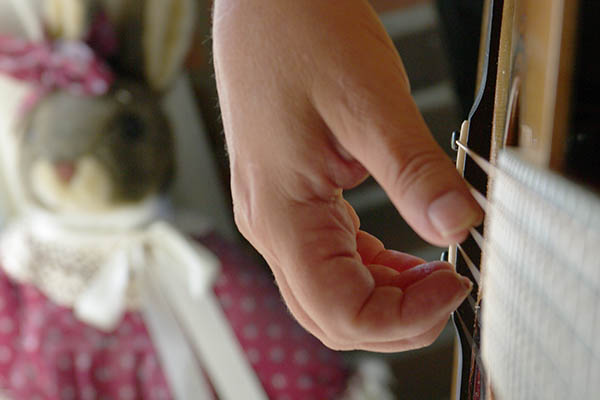
Finger picking hand techniques: (revised 7 Nov 2010)
Tablature is a form of notation for fretted instruments that goes back to the middle ages and flourished in the European renaissance, as for example this Dargesson holograph. The particular form of tablature provided here is my modification of the one that has evolved on the web. I've added note duration indicators, prettified the layout to some degree, and packaged it in PDF. For more information on basic text tab see How to read and write tab. To understand note durations see Unit 4 of my music theory tutorial, above.
It'll be some time (if ever) before I get all my chops back, so if my playing sounds a tad amateur, that's because it is. You have been warned.
In this track Mika, the African Grey, unexpectedly chimes in with a vocal track, throwing me off stride:
Not to be left out, Tabiki the Tres Marias Amazon has his say:
John Fahey's compositions inspired me to learn the guitar in the late '60s, then got me going again in 2010. There is an excellent, official John Fahey web site, most of which hasn't been updated since before the advent of YouTube. Here are some resources I feel should be referenced there but aren't:
Guitar video of John Fahey unknown date and venue
Guitar videos of John Fahey from 1969 playing his Bacon & Day:
Guitar videos of John Fahey from a performance in Germany:
The John Fahey video tutorials in the Stefan Grossman series:
Superb covers of several JF compositions on YouTube by Charlie Schmidt AKA FaheyPlayer – and on a guitar once owned by John Fahey, no less:
The Last Steam Engine Train, just the way it should be played. Macyn Taylor:
The Best of John Fahey contains 14 excellent tabs by Stan Ayeroff. It's now out of print but may occasionally be available on eBay, etc.