
Dale's Tutorial Tutorial
Version 1.4, © 2008 by Dale Cotton, all rights reserved
Depressingly, I get compliments on my writing far more frequently than on my pictures. I should probably sell my camera equipment and give up any remaining pretense I may have left of doing visual art. Yet good non-fiction writing is surprisingly easy to do. Here's all it takes:
Never assume knowledge of a fundamental
Elliot Falls 1. Are these pictures really so bad? They seem fine to me... ;(
If you're trying to explain chromatic aberration, you first have to explain refraction and the visible light spectrum (or at least refer the reader to such an explanation via a link), unless you know for certain that your audience will have the requisite background. So first outline your exposition, noting each sub-topic that needs explaining, then check that each concept or term you need to use in those explanations is either assuredly known to your audience or, if not, is explained previously in your document.
In other words, your thinking would be: "I want to explain X. In order to understand X you need to know W. In order to understand W you need to know V." So first you explain V, then W, then X. That's your outline. If X is something non-trivial, it's usually a bit more complex in that in order to understand X you probably need to understand W1, W2, and W3; and each of those concepts probably have their own precedent concepts, etc. Nevertheless, you end up with a certain number of concepts to explain, and you have to explain them in the order of their basic-ness, and you have to show how each concept leads to the next. Make a crude diagram of that on paper and you've got your outline.
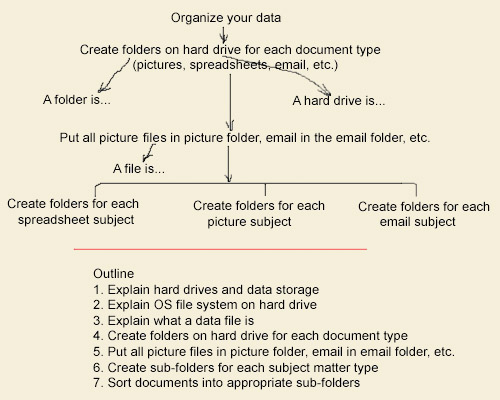
Fig. 1. First jot down ideas as they occur, then put them in explanatory order
The outline becomes the skeleton that the actual words you put on paper serve to flesh out. This tutorial started with four section headings then grew from there. And don't feel straight-jacketed by your initial outline; if you think of a better approach half way into your writing, modify your outline accordingly, then revise to fit.
Tip: Everything in this tutorial applies to business writing, but in addition there are many further considerations when writing business documents, especially as to organization and tone.
Write as if you were talking
You don't need to stare at the keyboard wondering how to phrase a passage. Just imagine yourself explaining the point in conversation with a friend, then type out what you would have said spontaneously in that context. If there's one thing that every human being past the age of three does well it's talking. People practice talking so incessantly, every single day of their lives, that one would think we all have a mortal fear of dysspeekia. Even when writing something highly formal, such as a term paper, write the first draft conversationally – make no attempt to formalize your language – then later go back to formalize as needed. For example: the header to this section started out as "Write like you talk".
Peterborough Greek Festival 3 These pictures have been inserted purely for visual interest; they have no relation to the text.
If your typing is not fast enough or effortless enough to keep up with the flow of your speech, consider using a voice recorder to capture your spontaneous phrasing, then type from the playback, then edit for formalities.
Keep both feet on the ground
The more abstract your topic the more you want to use concrete examples. (I suspect everyone knows this by now, I include it here chiefly for the sake of completeness.) You can explain refraction all you want; as soon as you say refraction is what causes your arm to appear bent when you immerse it in water, your readers will go "ah ha!". You can detail how the visible light spectrum is like an octave but of photon frequencies rather than of musical tones. But as soon as you say that a rainbow is the spectrum made visible, your readers will go "ah ha!".
That said, don't take this to the extreme of avoiding technical language entirely. You do your readers no favours by writing "bending of light waves" each time you are thinking "refraction" as you write. Introduce the word "refraction" with a concrete example, then use it freely thereafter. The next article your readers read, whether on photography or optics or astronomy, may well include the word "refraction" with no explanation and without ever tying it to the phrase "bending of light".
Self-edit
– but only after steps 1 and 2 – by reading every sentence critically. Ask yourself "what have I said here that could be misinterpreted?" This has two parts: concept and phrasing.
If you read anything scholarly, such as an article in a scientific journal, you'll find the flow is often tortuous. At every step the author considers all the objections his peers will surely raise and attempts to forestall them before proceeding to the next point. When writing tutorial material, one similarly needs to consider every possible way the reader will find to go off on a wrong tangent when reading your words. We've all sat in a classroom listening to the lesson being interrupted by question after question from fellow students: "you mean such-and-such?" To which the teacher has to respond: "no: I meant so-and-so". When writing a tutorial your job is to anticipate every such mis-take on your meaning, since you won't be there to answer each reader's questions as they arise.
Minden rapids 5. I've actually gotten compliments on this one...
At the conceptual level this is often a matter of trying to intercept your own unspoken presumptions. If you're writing a tutorial on apple farming and your experience is entirely with sweet varieties like the Macintosh, then everything you write assuming the goal is to maximize sugar content will be highly misleading to someone with a Granny Smith orchard ... and as I write that I wonder if my readers in Australia will even have heard of either of those apple varieties. So I would go back to add "(a sweet variety)" after Macintosh and "(a tart variety)" after Granny Smith, just in case. We can call this defensive exposition, in the same vein as defensive driving. ;)
At the phrasing level one checks that one's words say to other ears what they say to one's own ears. I write: "A tomato grower's first goal must always be to thin his plants." I read that to mean pruning unnecessary branchlets from each plant; you read that to mean pulling out plants that grow too closely to each other – a potentially costly misunderstanding!
Double-check
– for typos, spelling mistakes, punctuation problems, and grammatical errors.
Some errors are actually misleading, but all errors erode your creds as a competent dispenser of knowledge. In my experience, the single most common source of error has arisen with the advent of the microcomputer: cut-and-paste mistakes. I start to write: "Here in Ontario the rain always seems to fall on those who don't carry umbrellas". I intend to change that to: "The rain in Ontario falls mainly on those who don't carry umbrellas". But end up with: "Here the rain in Ontario falls mainly on those who don't carry umbrellas", because I cut the phrase "in Ontario", pasted it in the new location, then forgot to go back to delete the word "Here". The problem is that your eye expects to see what you believe you've written and so never sees the orphaned "Here" at the beginning of the sentence.
The obvious and best solution is to have someone with good language skills proof-read for you. Such people are hard to find ... and generally prove less willing to comply with each repeat request ... so you may as well polish your self-editing skills, you'll probably need them. Alternatively, brag to your spouse what a wonderful writer you are, then sit back, pretending to be hurt, as he/she points out problem after problem in your hard copy. If that's not an option, and you have the luxury of time, put your document aside for several days. With a good bit of luck you'll be able to read it with a fresh eye, hopefully catching some of those pesky hidden errors.
Fenelon Falls Lock 4
For all that I've encouraged you to start by recording your conversational flow, another source of problems are colloquialisms that are so familiar to the ear that they easily go unnoticed. You may try and solve this problem in your daily speech, but in the final draft of your writing you want to try to solve this problem. Few readers will consciously object to "try and"; but equally, few readers will fail to come away with a vague impression of amateurishness.
Similarly, in our daily speech we tend to leave out seemingly unnecessary or repetitive words and phrases. For example: this tutorial starts with: "Depressingly, I get compliments on my writing far more frequently than on my pictures." In conversation we all too often leave out that second "on". Another example: in my first draft of this section I wrote: "Double-check for typos, spelling mistakes, punctuation, and grammar." I didn't really intend to suggest that you check for the existence of punctuation and grammar in your writing; I'm sure most of us would have understood my intended "punctuation problems, and grammatical errors". Nevertheless, Mr Spock would have called me out on a logic error; and we don't want to argue with Mr Spock. Which leads me to my final gem of sheer sagacity:
Tip: Never write, but always proof, as though there are two people standing behind your back, reading over your shoulder. One is Mr Spock, checking your logic and your facts; the other is Miss Primly, your sternest, pickiest, least forgiving public school English teacher, critiquing your language.
Appendix: Persnicketies for the obsessive-compulsive
The above is what you really need to know. If you have been, or expect to be, writing more than very infrequently, you may want to read on:
Tone
- While editing, don't ignore tone. Many people assume that non-fiction writing has to be stiffly formal. Instead, your tone should suit your context and your audience. If you've followed the suggestions so far, you've written a first draft in natural, colloquial language following the structure of your outline. That speech-like naturalness of tone is actually your greatest asset, if keeping your readers interested has any importance.
- On the other hand, the more conversational your tone, the more you reveal yourself as a person. A light tone with a dash of humour may bring your readers on-side; going just a hair too far in that direction may come across as immature or distracting. Tilting at the occasional windmill may add a bit of spice; attack one too many and you've painted yourself as mean-spirited. Your readers will give you the benefit of the doubt and assume you're a really nice person ... so long as you don't inadvertently reveal the true you. ;)
Wording
- Use connectors liberally. Rather than writing Point A. Point B. Point C. Instead write: Point A. But note that Point B. And likewise Point C. Often connectors don't add to the meaning of what you write; but instead serve to preserve the flow, retaining your reader's attention.
- Eliminate unnecessary words (without destroying flow or tone). I initially ended the previous tip with "preserve the flow, and therefore retain your reader's attention".
- "And" is probably the most overused word in the English language. During your proofing try to replace the word "and" with some other, more descriptive word (or even just a comma) whenever possible. I went to the store and bought some milk and cookies and went home to have a snack. I went to the store, bought some milk and cookies, then went home to have a snack.
Voice
- First person pronouns. You may have been taught to avoid first person pronouns: "I", "me", "mine", etc., when writing, and instead use the royal "we" if a pronoun can't be avoided. This quaint mannerism is attempting to quietly die along with the Victorian Era, so leave it to find its rightful place along with "thou", with "shalt", and with the neck tie male workers used to wear to the office with white shirt and dark pants.
- Passive voice. You may also have been taught that the passive voice should never be used. ;) Most passive phrasings are indeed improved by rewriting in the active voice; ;) but occasionally the passive is less awkward or even more correct.
Punctuation
- Punctuate defensively. Your English teacher may have taught you that punctuation is logical and logic says no comma is needed if blah-blah-blah is true; but the comma is needed wherever it clarifies your meaning, so the reader gets your drift the first time through. Often there are two ways to read a passage and a comma or other mark prevents the reader from taking the wrong turn. For example: in the previous sentence, as it stands without the comma, there's nothing to stop you from assuming "there are two ways to read the combination of a passage plus a comma".
- If you're deeply into writing, you will have noticed my colourful use of colons, semi-colons, and dashes. Punctuation is really a stylistic matter in spite the best efforts of grammarians. By far the most common approach among professionals is to use the comma almost exclusively within a sentence; and to start a new sentence rather than join complete phrases with a semi-colon or similar. If you're writing professionally, you may as well adopt or retain this minimalist style; otherwise you'll forever be at loggerheads with your editor-du-jour.
|